

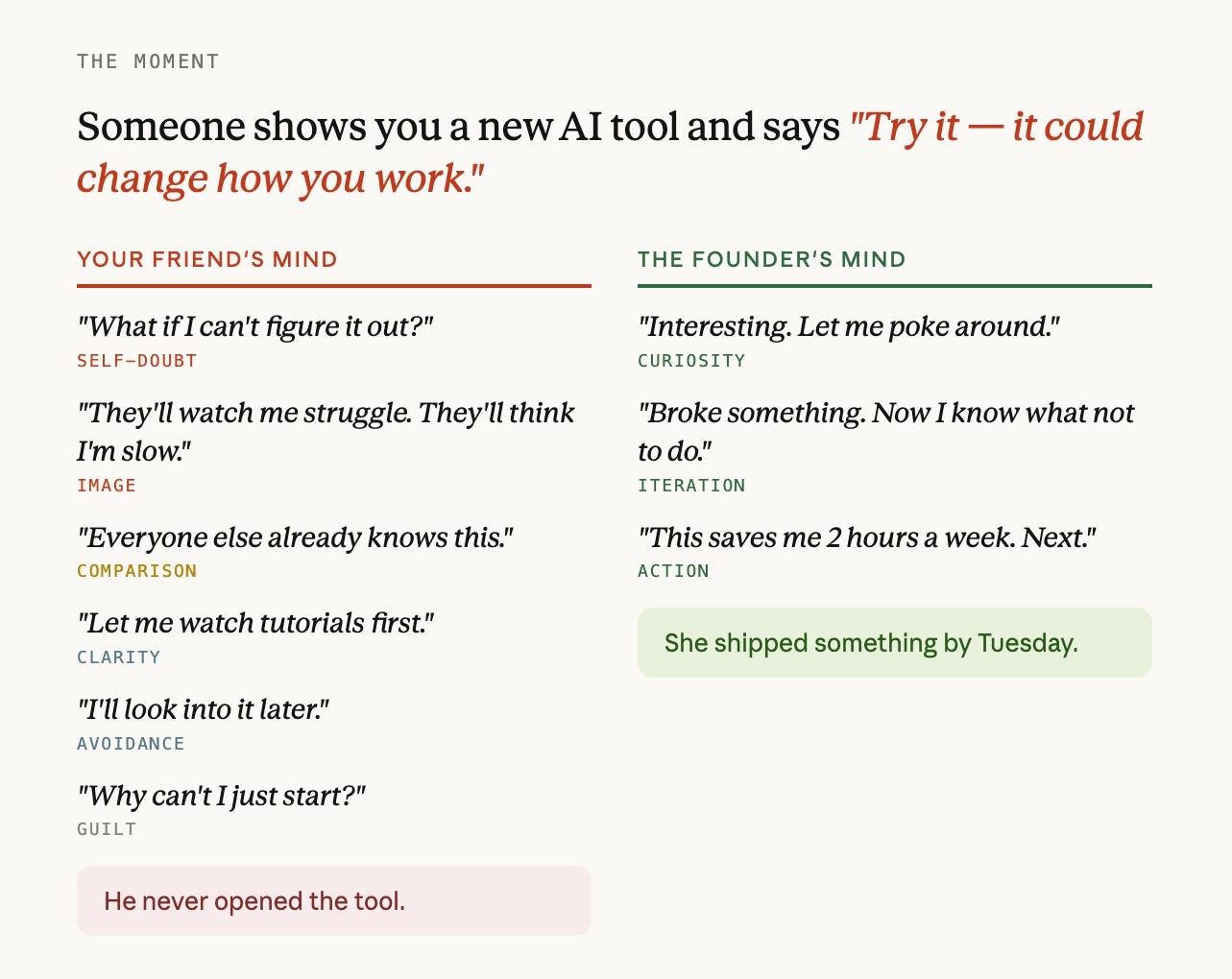
Last week, I showed a friend a simple way to make extra income with a new AI video tool.
He’s a smart guy. College-educated. Years of experience. Fully capable. And I knew he was curious about AI video generation.
This should have been a ten-minute conversation: here’s the tool, here’s how it works, give it a shot.
But instead, he asked:
“Can I even learn this?” “What if I mess up?” “What if they think I’m stupid?”
He never opened the tool.
Here’s why it hit me so hard.
I’m in the Bay Area. I spend my weeks talking to founders who’ve IPO’d, Stanford / MIT PhDs, and investors in well-known VCs.
When these people encounter a new tool? They click around. Break stuff. Figure it out. No ceremony. No crisis.
Same 24 hours. Same brain. Completely different output.
I used to think the gap was intelligence. Then confidence. Then experience.
Wrong on all three.
The real difference is internal friction.
The Friction Tax
Every action you take passes through a pipeline. An idea enters your mind — and before it becomes action, it has to survive a gauntlet.
Each question is a toll booth. Each one extracts energy.
Am I smart enough? What will people think? What if I fail publicly? Maybe I should research more first. Let me wait until I feel ready.
By the time the idea reaches your hands, it’s either too weak to move you — or it’s dead.
High friction mind: Idea → Self-doubt → Rehearse failure → Fear → Delay → Avoidance → Guilt → ...maybe act (8% energy left)
Low friction mind: Idea → Try → Adjust → Next (92% energy left)
It’s not that the best people have more hours. They just lose less energy to internal drag.
It’s Not About Ability. It’s About Permission.
My friend’s problem wasn’t that he couldn’t learn the tool.
It was that he couldn’t give himself permission to be a beginner.
Underneath most procrastination, there’s a hidden equation:
“If I try and fail, it means I’m not good enough.”
So people don’t try. Not because they’re lazy — because failing would cost them their self-image.
The avoidance isn’t a bug. It’s a protection mechanism.
The best founders have cracked this. They’ve separated “I don’t know this yet” from “I’m not worthy.”
That sounds simple. It’s one of the hardest things a person can do.
Introducing: The Friction Stack
After watching this pattern in my friend, in myself, in dozens of conversations — I started naming the exact forces that block action.
Not vague “resistance.” The specific inner voices.
I call it The Friction Stack — twelve frictions that live between intention and action, in four tiers.
Steven Pressfield called this force “Resistance” — one monolithic enemy. Huberman added neuroscience with “limbic friction.” The Chinese concept 内耗 (nèihào) captures the burnout of excessive internal conflict.
The Friction Stack breaks all of this into twelve named species — because “I have resistance” isn’t actionable. But “Image and Shame are firing at the same time” — that you can work with.
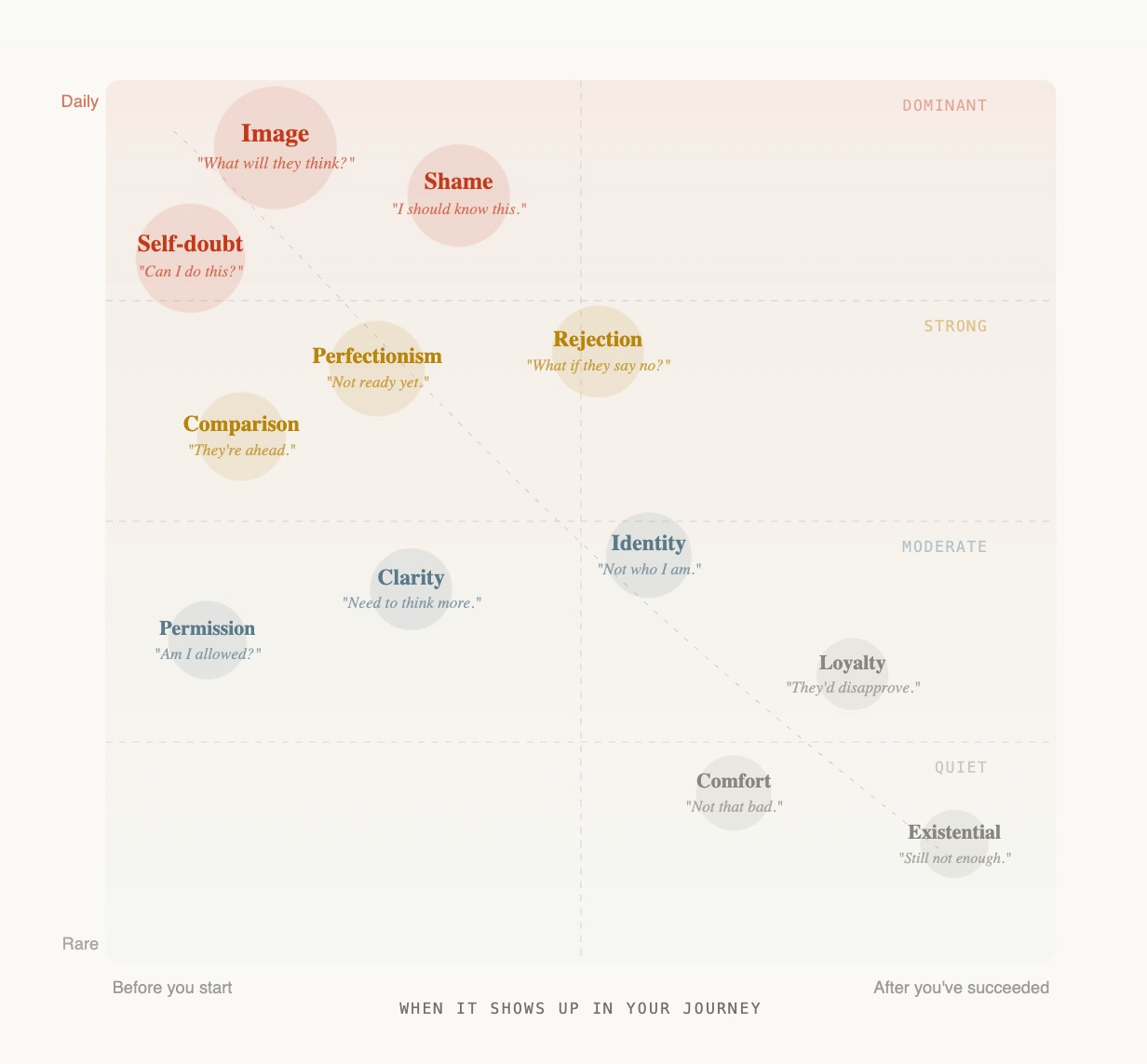
Here are the twelve:
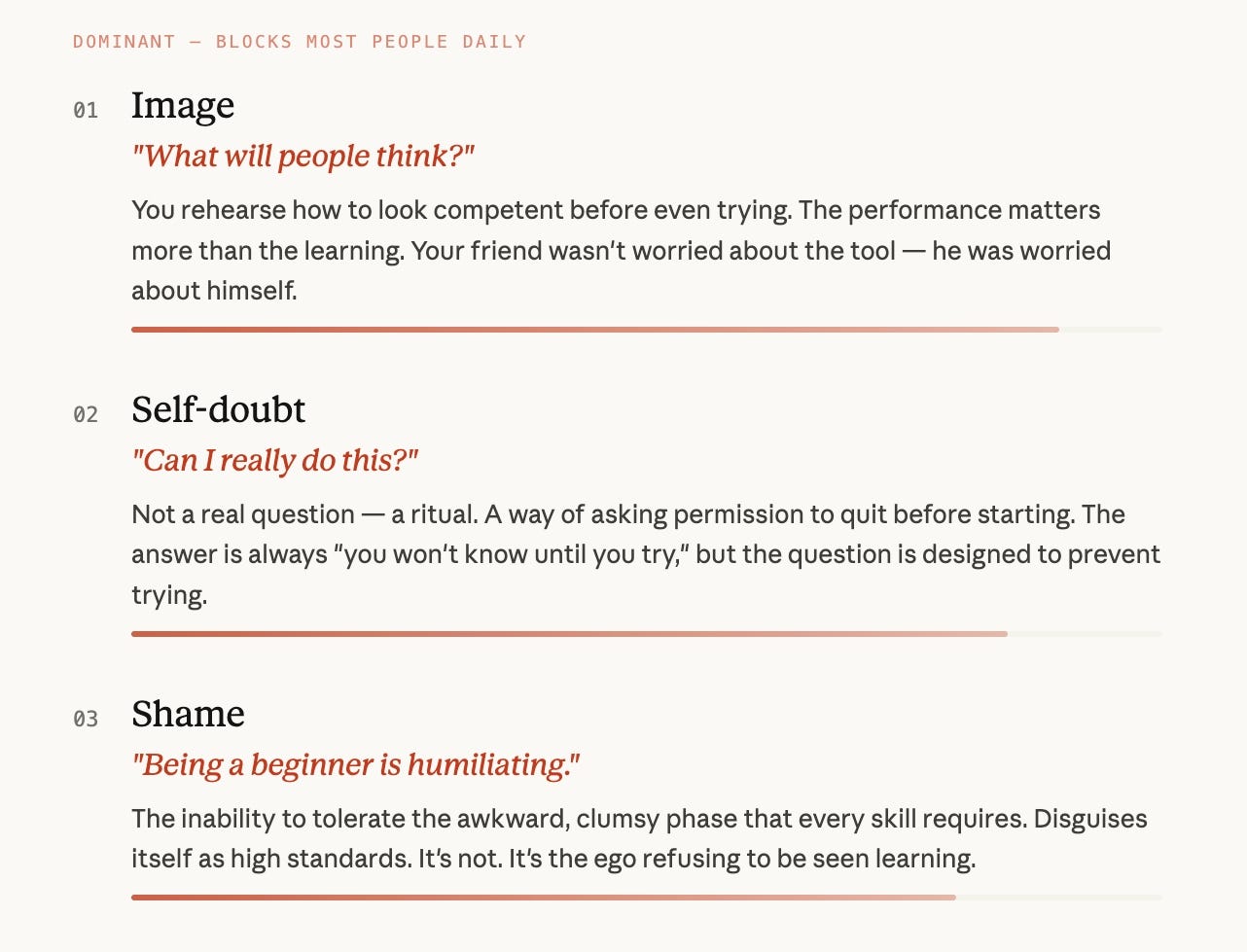
Tier 1: Dominant — these block most people daily
Blocks most people daily. Fires before you even start.
01 — Image “What will people think?” You rehearse how to look competent before even trying. The performance matters more than the learning.
02 — Self-Doubt “Can I really do this?” Not a question — a ritual. Designed to give you permission to quit before starting.
03 — Shame “Being a beginner is humiliating.” Disguises itself as high standards. It’s not. It’s the ego refusing to be seen learning.
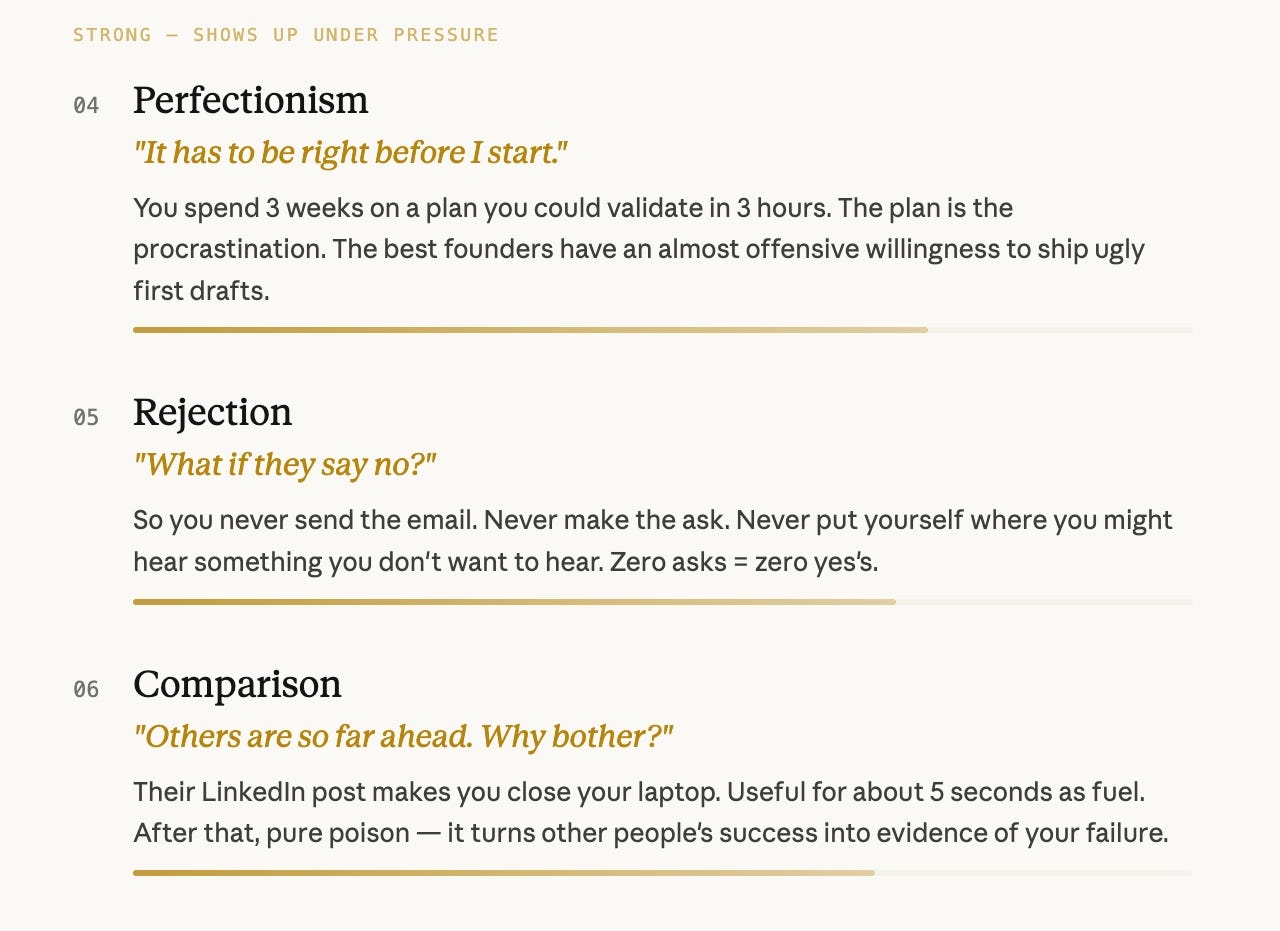
Tier 2: Strong — these show up under pressure
Shows up under pressure. Drains energy daily.
04 — Perfectionism “It has to be right before I start.” You spend 3 weeks on a plan you could validate in 3 hours. The plan IS the procrastination.
05 — Rejection “What if they say no?” So you never ask. Never pitch. Never reach out. Zero asks = zero yes’s.
06 — Comparison “Others are so far ahead.” Their LinkedIn post makes you close your laptop. Other people’s success becomes proof of your failure.
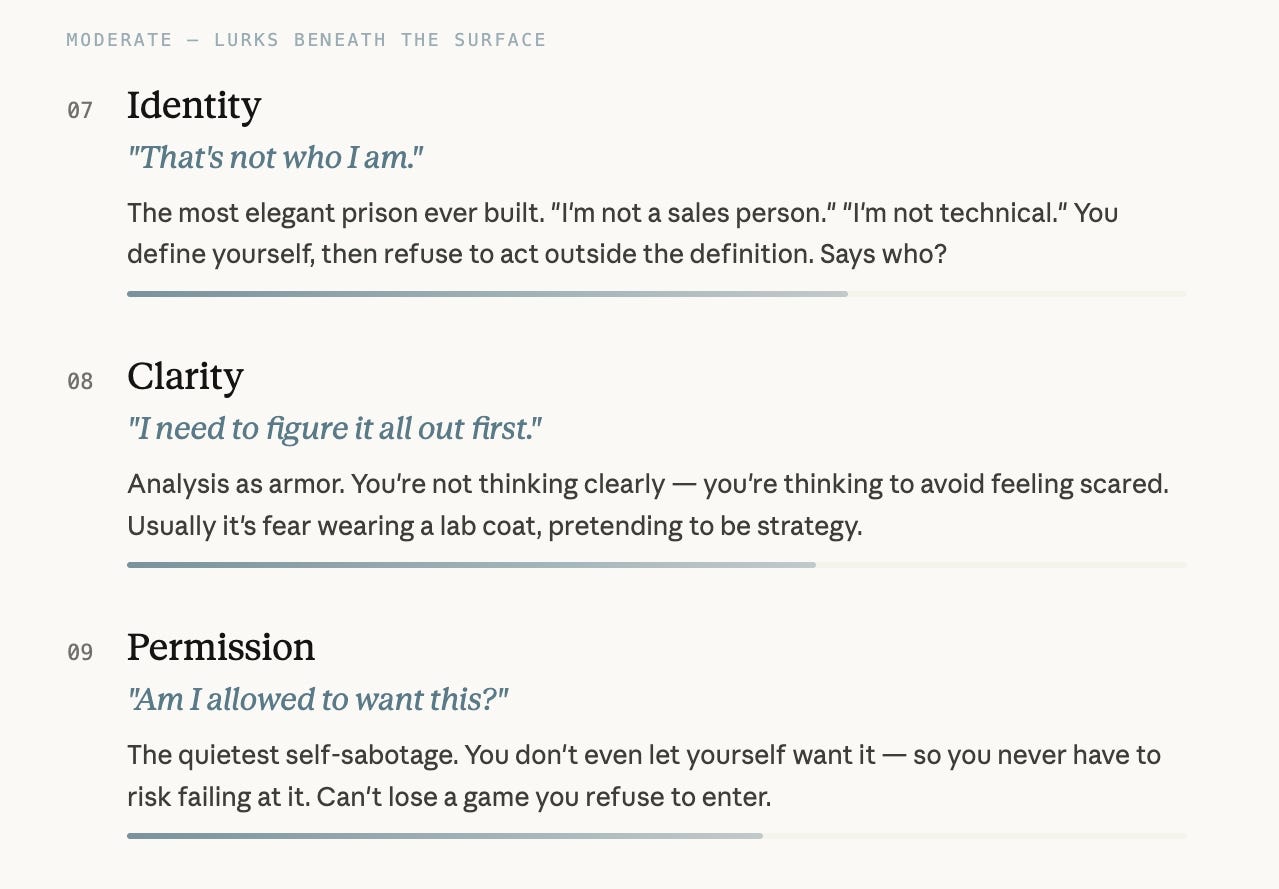
Tier 3: Moderate — these lurk beneath the surface
Lurks beneath the surface. Operates below awareness.
07 — Identity “That’s not who I am.” The most elegant prison ever built. You define yourself, then refuse to act outside the definition. Says who?
08 — Clarity “I need to figure it all out first.” Fear of wearing a lab coat, pretending to be an analyst.
09 — Permission “Am I allowed to want this?” You don’t even let yourself want it. Can’t lose a game you refuse to enter.
Tier 4: Quiet — rare, but runs deep
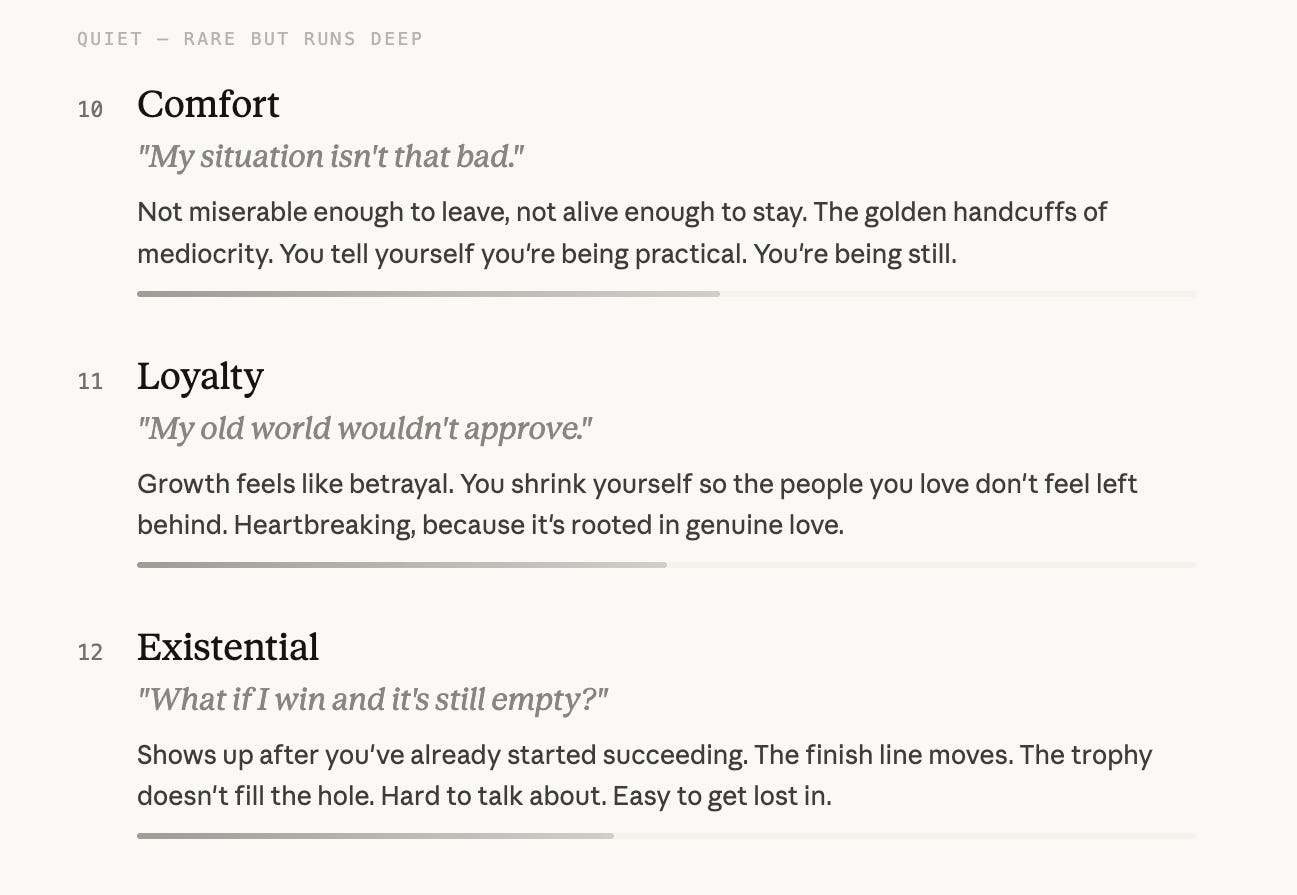
Rare but deep. Often arrives after you’ve already succeeded.
10 — Comfort “My situation isn’t that bad.” Not miserable enough to leave. Not alive enough to stay. The golden handcuffs of mediocrity.
11 — Loyalty “My old world wouldn’t approve.” Growth as betrayal. Rooted in genuine love for people who can’t follow where you’re going.
12 — Existential “What if I win and it’s still empty?” The finish line moves. The trophy doesn’t fill the hole. This one arrives after you’ve already made it.
Most people carry 3–4 active frictions at any time.
My friend was hit by three at once — Image, Self-Doubt, Shame — all from being shown an AI tool.
The strongest people haven’t eliminated their stack. They’ve reduced the dominant ones to a manageable hum.
What the best founders actually do differently
They’re not fearless. Some are anxious, neurotic, full of doubt.
But fear doesn’t get veto power.
It shows up. They notice it. They act anyway. The fear passes through like weather — it doesn’t move in, redecorate, and start holding meetings.
Most people spend 80% of their energy managing internal state. 20% doing the work.
Flip that ratio and you become dangerous.
The founders who move like water — 知行合一, unity of knowledge and action — haven’t killed their friction. They’ve shortened the gap between feeling and doing:
→ They catch self-deception fast. “I’m not procrastinating, I’m—” Nah. I’m scared. Let me do it anyway.
→ They separate temporary incompetence from permanent identity. Bad at something Tuesday, fine with it Wednesday.
→ They start ugly. First drafts, first calls, first pitches — terrible. They don’t care. The iteration is where magic happens.
→ They stay close to reality. Instead of modeling how things should go, they find out how things actually go.
This isn’t personality. It’s practice. Thousands of reps of choosing discomfort over avoidance.
The lies your friction tells you
Here’s the uncomfortable part:
Most of what we call “strategy” is actually sophisticated avoidance.
“I need more market research” → I’m afraid to talk to customers.
“I’m waiting for the right co-founder” → I don’t want to start alone and look small.
“The timing isn’t right” → I’m not ready for what success would demand.
“I need to think about it more” → I already know what to do. It scares me.
The best founders have an allergic reaction to their own bullshit.
Each time they catch an excuse and act anyway — they shave a layer off the stack.
Why “just think positive” doesn’t work
There’s a layer below psychology: your nervous system.
Some people freeze when they hit uncertainty. Not metaphorically — their body downregulates. Heart rate shifts. Breath shallows. The thinking brain goes offline. The survival brain takes over.
This is why you can know what to do and still not do it.
Knowledge lives in your prefrontal cortex. Resistance lives in your amygdala.
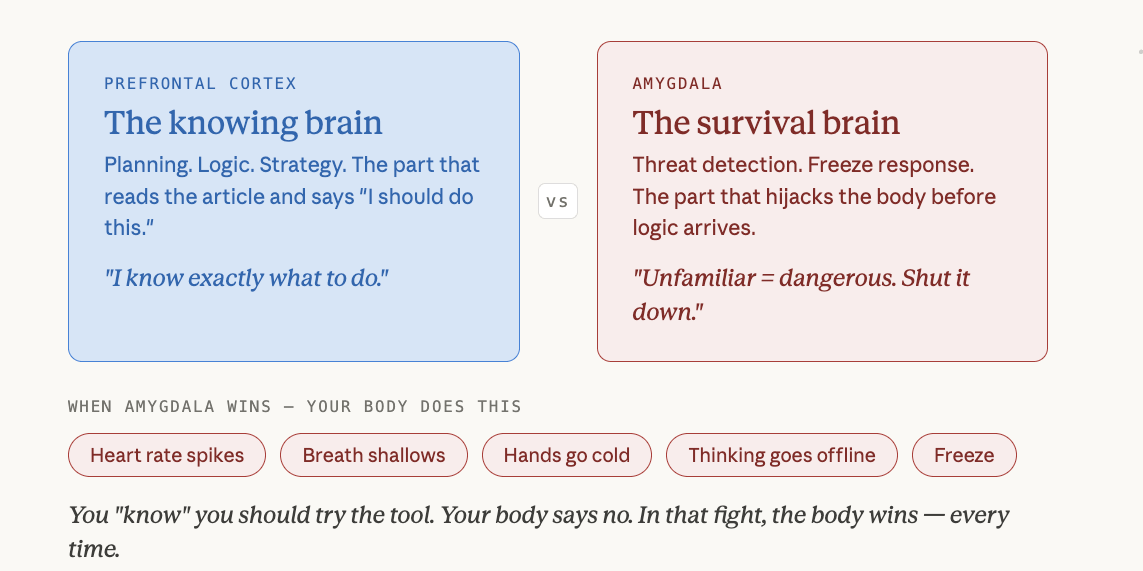
In that fight? Amygdala wins. Every time.
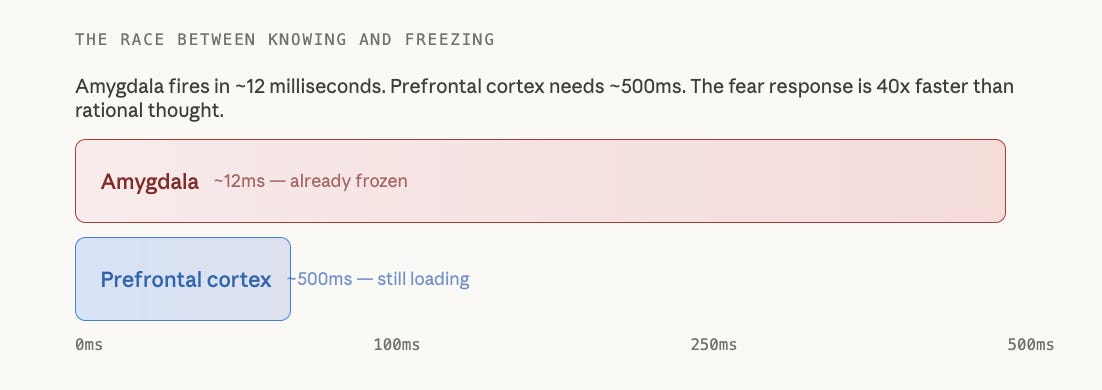
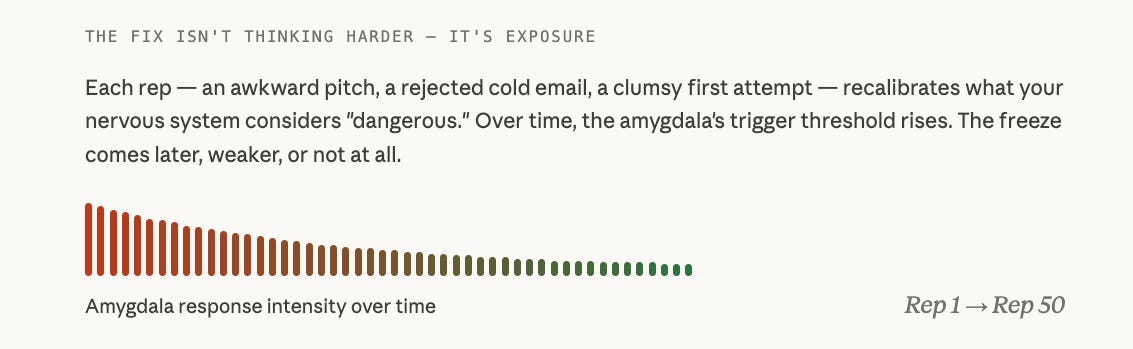
Unless you’ve trained yourself through exposure. The founders who stay calm in chaos haven’t suppressed fear — they’ve expanded their capacity to hold uncertainty without shutting down.
Your system needs reps, not concepts.
Growth is subtraction
Most advice is additive. Read more. Learn more. Add more skills.
The deepest growth is subtractive:
Remove the story that you need to be perfect before starting. Remove the habit of rehearsing failure before trying. Remove the need to look smart instead of being effective. Remove the belief that discomfort means something’s wrong.
Each one removed = instant energy back.
You don’t need to become a different person. You need to stop spending energy being someone you’re not.
What’s left is flow. Ease. Moving like water. Not superpowers — just less drag.
That’s the goal of working with your Friction Stack. Not to add armor. To remove weight.
The Real Game
My friend still hasn’t tried the tool.
The tool doesn’t matter.
Somewhere inside him is a version of himself that would just... open it. Click around. Feel dumb for twenty minutes. Get less dumb. Try again.
That version isn’t blocked by ability. It’s blocked by his Friction Stack — Image, Self-Doubt, and Shame firing at once.
The work — the real work — is reducing that stack. One friction at a time.
Not becoming fearless.
Just making fear a worse driver than curiosity.
They’re not fearless. They just stopped negotiating with their fear.
And that, more than any Stanford degree or Series A, is what makes them move.
Co-authored with Claude. Framework co-built with Claude. What it builds on — Pressfield’s Resistance (the force), Huberman’s limbic friction (the neuroscience), …
What’s the loudest friction in your stack? Sometimes naming it is the first step to quieting it.